Ashbourne Primary School
Religious Education
Religious Education at Ashbourne Primary School
We equip pupils with an awareness and understanding of a range of faiths and world-views, preparing them to live in a diverse and contemporary society.
At Ashbourne Primary, RE encourages pupils to ask meaningful questions, challenge misconceptions and develop tolerance, respect and understanding. Through learning about different religions and beliefs, pupils gain insight into how faith and values influence people’s lives.
All pupils have the opportunity to visit places of worship and take part in faith-based workshops, helping them to experience and understand difference in people, communities and beliefs. This supports pupils in developing an inclusive and respectful attitude towards others.
Curriculum Progression
Our RE curriculum is carefully planned and sequenced to ensure progression across the school:
- Key Stage 1 – pupils are introduced to key beliefs and practices within Christianity, Islam and Judaism
- Lower Key Stage 2 (Years 3 and 4) – pupils revisit and deepen their understanding through a two-year rolling programme
- Upper Key Stage 2 (Years 5 and 6) – pupils extend their knowledge to include a wider range of religions and worldviews, including Hinduism and Humanism
Across Key Stage 2, pupils study Christianity, Islam, Judaism, Hinduism and Humanism, developing a broader understanding of belief systems.
Each year, pupils take part in visits to places of worship or faith-based workshops, providing meaningful and memorable learning experiences.
We recognise that learning takes time and repetition. Our curriculum is designed to ensure that key knowledge and concepts are embedded in pupils’ long-term memory, enabling them to deepen their understanding over time and apply their learning in different contexts.
Linked to Our Golden Threads
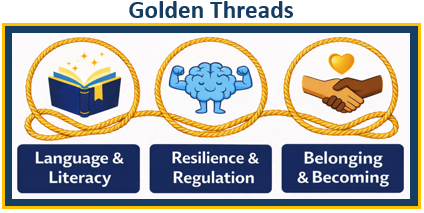
Our RE curriculum supports our Golden Threads:
- Language and Literacy – pupils develop the vocabulary to discuss beliefs, values and ideas clearly and respectfully
- Resilience and Regulation – pupils learn to reflect, question and consider different viewpoints thoughtfully
- Belonging and Becoming – pupils develop respect for others, understanding diversity and their place within a wider community
Through our RE curriculum, pupils:
- -Develop knowledge and understanding of a range of religions and world-views
- -Build respect and tolerance for different beliefs and cultures
- -Learn to ask questions and think critically about important issues
- -Develop an inclusive attitude towards others
- -Are well prepared to live in a diverse and multicultural society


